Support Your Local Astronomer!
Google Maps LIVE on X with Schoening and
.TLE updating with Dillon
Recently I was singularly impressed with the mapwork of one Andrew SchOening who, to his credit, made them available for personal use. And while I am less than
and Dillon SXM-10 Graphic and Map Creation
Suborbital launches from Wallops Island, VA
Wallops Flight Facility continues the NASA Commercial Space Launch Program. Adding low-orbit Firefly launches in addition to Antares.
"Wallops conducts extended hours outreach events routinely at the Visitor Center, which is located on Virginia Route 175 about five miles from U.S. Route 13 and five miles from Chincoteague Island, Virginia."
It is worth noting Grumman is scheduling Antares out of the Cape, sadly.
Wallops is managed under the auspices of the
Virginia Commercial Space Flight Authority
4111 Monarch Way, Suite 303
Norfolk, VA 23508
(757) 440-4020
The launch facility is transforming into the
Mid-Atlantic Regional Spaceport (M.A.R.S.)
- Latitude: 37.8 degrees N
- Longitude: 75.5 degrees W
All the while remaining as historic Wallops Island, Virginia.
Find more information on this exciting endeavor at
Shoutout to Maryland-Delaware Rocketry Association (MDRocketry.Org)
MDRA ESL 302 Central Sod Farm
July 27 @ 12:00 pm - July 28 @ 3:30 pm EDT
MDRA will be hosting ESL 302 at the Central Sod Farm on:
Saturday July 27th from ~12:00 pm to ~5:00 pm
Sunday July 28th from ~9:00 am to ~3:30 pm
NASA's Main Eclipse Site includes a Countdown Clock
More INFO available here as well
Eclipse maps using various projections
- The Great American Eclipse site has some of the best information on this spectacle of Nature.
- It cannot be overstated that you risk damaging your eyesight during the partial phases.
- Image page of circumstances of this eclipse by Dr. F. Espenak.
- I have created a KML file of the Two minute 40 second path - The maximum time this eclipse offers.
Perhaps you've heard a phrase, such as 'Sic Itur Ad Astra'. . .
I volunteer at the
Located in the far corner of Big Oak Park - follow the road to the silver dome!
585 Big Oak Road
Smyrna, Delaware 19977
(302) 659-5003
- from the Astronomical Applications Department of
USNO's The Astronomical Almanac Online!
Skygazer's Almanack for 40 Degrees North
- Compliments of Sky Publishing
http://sunearthday.nasa.gov/spaceweather
23 YRS of Orbital Rocket Science -
Dedicated. Knowledgeable. Brilliant!
LIVE Coverage on NASA TV
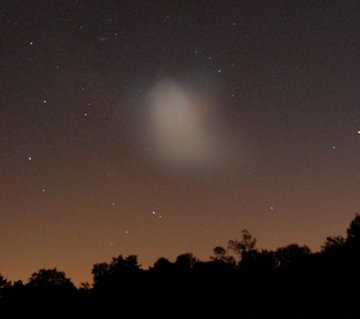
@StargazerUSA On Saturday night, September 19 around 7:50 p.m. EDT, it looked like a passing comet or a giant, luminous amoeba. But this was pure rocket science. Courtesy of Wallops Island Flight Facility, in Virginia.
The cloud was created by a Black Brant XII sounding rocket.
An Event 400 Years in the Making
"Comets and Life On Earth"
Shuttle / ISS Visibility Predictions
for Dover, DE
for Dover, DE
Not near Dover?
For NASA TV streaming video, scheduling and downlink information, visit:
NASA will provide continuous mission updates online, including a webcast and a blog, at:
http://www.nasa.gov/shuttle
Live updates to the NASA News Twitter feed will be added throughout the shuttle launch countdown, mission and landing. To access the NASA News Twitter feed and other agency Twitter feeds, visit:
http://www.nasa.gov/collaborate
IOTA Occultation Manual free Download
The International Occultation Timing Association (IOTA) has just released a new book on Occultations. It's a free, online and ready for downloading PDF file. It is 388 Pages.
If you like to time the disappearance of stars (and asteroids, planets. . . ) and reappearances along the lunar limb, you will find this manual to be a great resource.
http://www.poyntsource.com/IOTAmanual/Preview.htm
From the Preview Website:
"The International Occultation Timing Association (IOTA) wants you for the most exciting observations you can make – occultations ! Never before has there been an opportunity to contribute to the body of scientific knowledge about the lunar limb profile and the size of shape of asteroids plus a host of other occultation phenomena. . ."
"Occultations occur when one celestial body passes in front of another, temporarily blocking its light. The observation of these "eclipse" events provides important information on the celestial body responsible for the eclipse. . ."
"All astronomers, both amateur and professional, can make occultation observations.This book has all the necessary information one needs to begin a successful occultation program. Whether you are a novice observer, or an advanced observer with a video system, you can assist in the search for asteroidal moons, help discover new double stars and help determine the size of the Sun during solar eclipses. . ."
"Written by IOTA's most experienced astronomers, this is the only book you'll need for occultation observations of stars by the Moon, by asteroids, and other solar system bodies. It includes an extensive set of Appendices, and over 120 figures and diagrams, 388 pages.
Chasing the Shadow: The IOTA Occultation Observer'sManual
- is currently online, FREE as an e-book. . ."
Go straight for it:
http://www.poyntsource.com/IOTAmanual/IOTA_Observers_Manual_all_pages.pdf
Thanks go out to the AOS for the link!